
 EN

The evolution of ballistic helmets
1. First Generation: Steel Helmets – Stopping Shrapnel, Not Bullets
During World War I, the French military was the first to issue steel helmets to their troops. The sole purpose back then was to protect against shrapnel from exploding artillery shells. On the battlefield, shrapnel accounted for over 70% of casualties. A piece of shrapnel the size of a fingernail, flying at supersonic speeds, was enough to pierce a skull. A steel helmet just a few millimeters thick could disperse this energy across a wider area, turning a "certain death" into a "minor scratch."
However, steel helmets couldn't stop bullets. The kinetic energy of a rifle bullet is dozens, or even hundreds of times greater than that of shrapnel; to a steel helmet, it was like paper. Steel helmets also had other drawbacks: they were heavy (weighing 1.5 to 2 kg, causing neck fatigue after a day's wear), offered no protection to the sides or back, and had primitive padding that transferred the blunt force directly to the skull.
Representative Models: Germany's M1916, the US M1, and China's GK80. They protected two entire generations of soldiers, but their limitations were obvious.
| Helmet Generation | Material | Weight | Protection Level | Main Drawbacks |
| 1st Gen | Steel | 1.5-2kg | Shrapnel | Heavy, non-ballistic |
| 2nd Gen | Aramid | 1.2-1.5kg | Handgun rounds | Still relatively heavy |
| 3rd Gen | Aramid/Carbon Fiber | 0.8-1.1kg | Rifle rounds | Expensive |
2. Second Generation: Aramid Helmets – Ballistic Protection, Lighter Weight
In the 1970s, DuPont invented Kevlar (aramid). This golden fiber is five times stronger than steel wire but only one-fifth of its density. Helmets made from it weighed just two-thirds as much as steel helmets while offering the same level of ballistic protection.
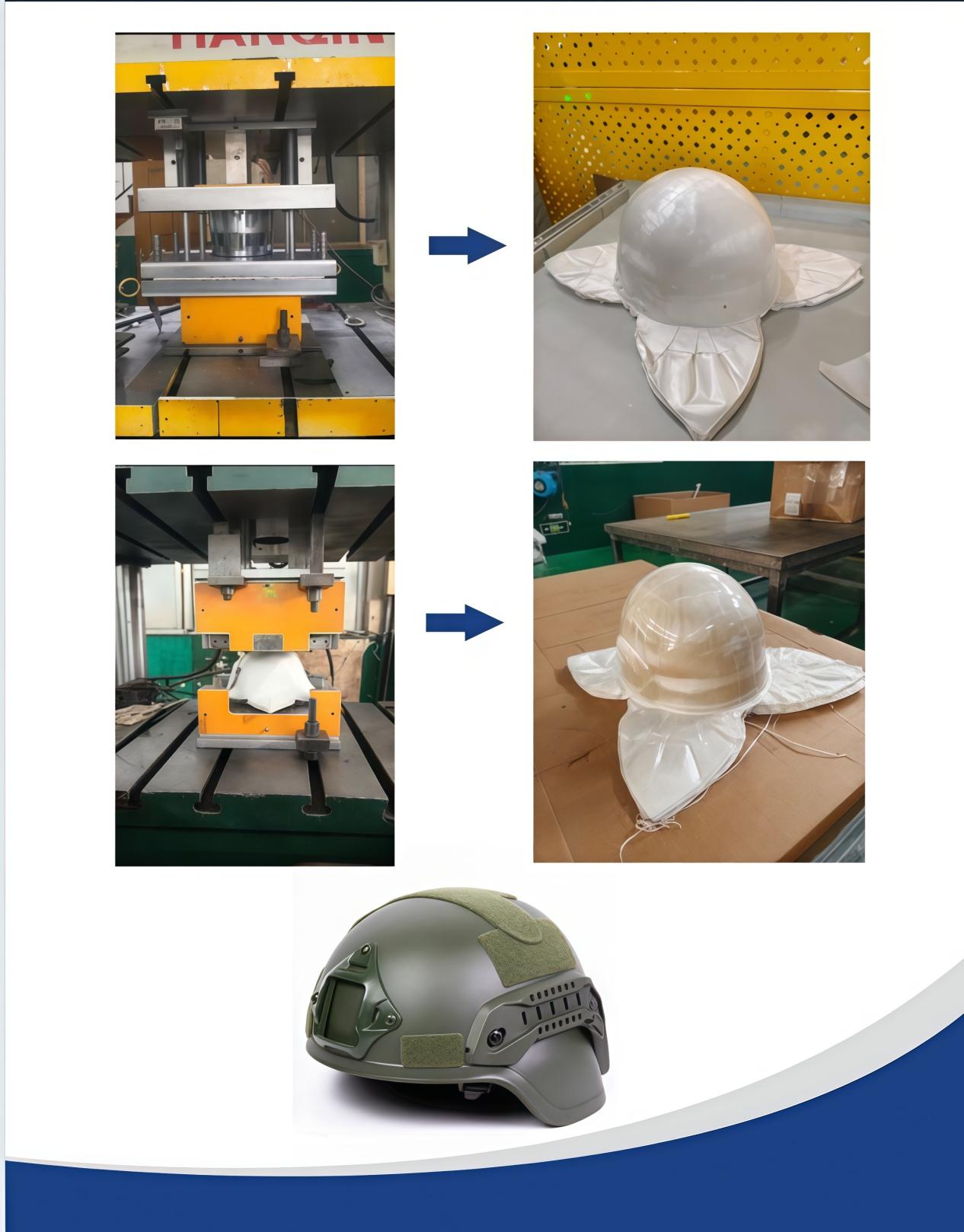
Aramid doesn't stop bullets by being "hard"; it works like a "soft net." When a bullet hits, the fiber layers catch it like a massive web, absorbing kinetic energy through stretching and breaking. A ballistic helmet typically consists of dozens of layers of aramid unidirectional fabric (with fibers aligned at specific angles), which are then cured in a mold under high temperature and pressure.
The aramid helmet upgraded head protection from "shrapnel resistance" to "handgun defense."
Representative Models: The US PASGT helmet (nicknamed the "Fritz helmet"), issued in the 1980s and used through the Iraq War. China's QGF02 aramid helmet was also a product of this era.
3. Third Generation: Composite Helmets – Carbon Fiber Enters the Fray
In the 21st century, battlefield threats escalated. The penetrating power of AK-47 rounds far exceeded that of handgun bullets. Achieving rifle protection with pure aramid required 40 to 50 layers, pushing the weight back over 1.5 kg—back to steel helmet levels.
The solution was adding carbon fiber. Carbon fiber has a much higher modulus (stiffness) than aramid. Upon impact, the carbon fiber layer disperses the shockwave across a larger area much faster, slowing the bullet down. By alternating layers of carbon fiber and aramid, the protection level could be upgraded to stop rifle rounds without significantly increasing the weight.
Representative Models: The US Enhanced Combat Helmet (ECH), issued in the 2010s. The glossy black exterior of the ECH is the signature of its carbon fiber layer. China's QGF11 helmet also adopted an aramid/carbon fiber hybrid structure, capable of stopping rounds from the Type 56 submachine gun.
4. The Next Generation: UHMWPE Helmets Are on the Way
An even lighter material has emerged: Ultra-High-Molecular-Weight Polyethylene (UHMWPE). It is lighter than water, yet stronger than both aramid and carbon fiber. Helmets made from UHMWPE are 20% to 30% lighter than aramid helmets for the exact same protection level.
A UHMWPE helmet with handgun protection can weigh under 800 grams—lighter than two bottles of mineral water. Soldiers can wear it all day without fatigue, and the material's excellent toughness provides high resistance to multiple hits.
However, it has its flaws: it is sensitive to heat (softening at 150°C) and cannot achieve a glossy finish like carbon fiber (making it less aesthetically pleasing). Therefore, UHMWPE helmets are currently mainly used by special forces, while regular troops still rely on aramid/carbon fiber hybrids.
